Two funny shows I watched last semester and sort of understood in languages I speak (Marathi) and don't (Hindi), and some reflections on speaking heritage languages as a third-generation immigrant
March 01, 2026
Mi Marathi bolato
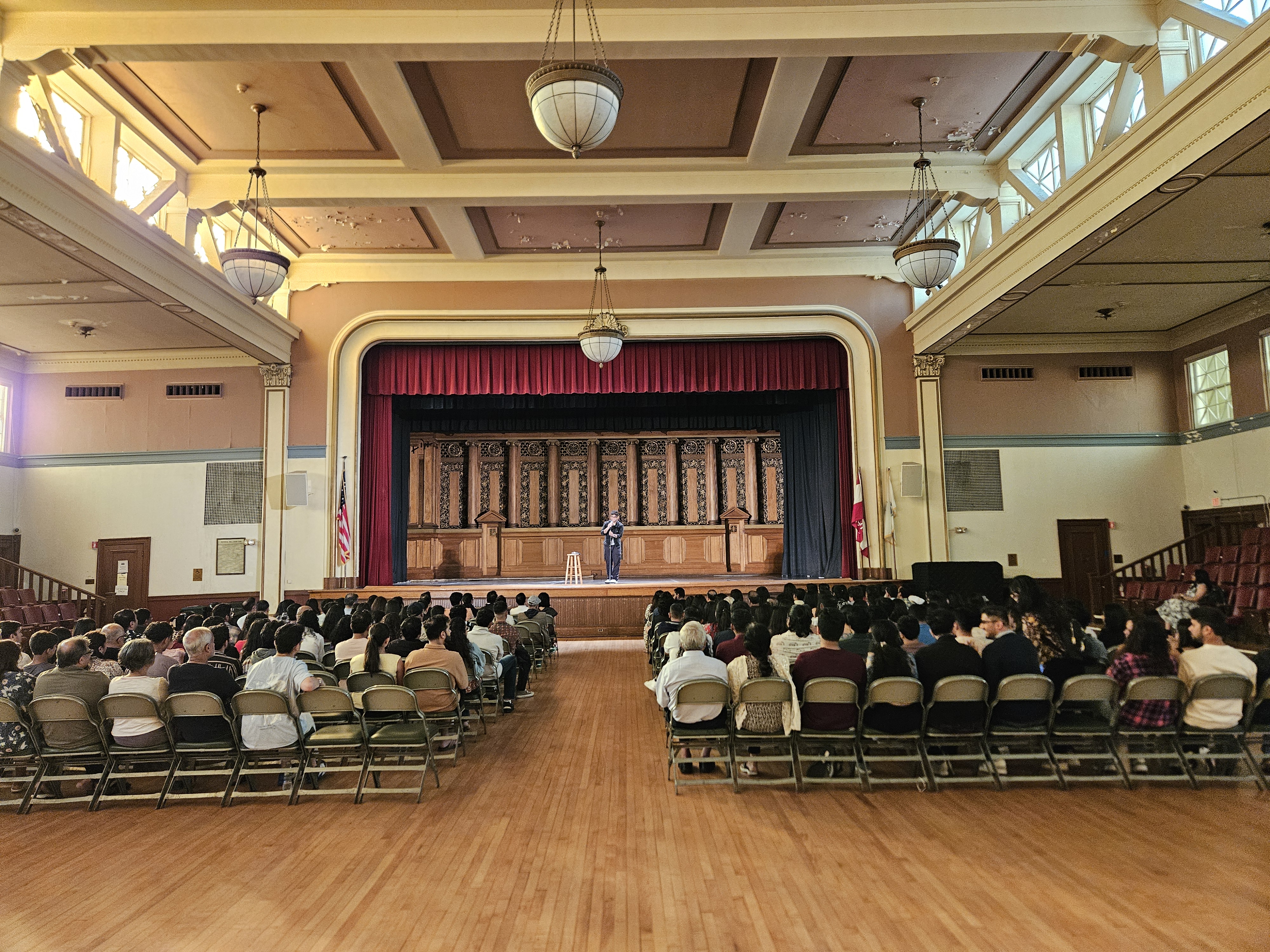
In August, I was browsing Sulekha (as one does) when I came across a listing for a (well-known) Marathi stand-up comedian named Sarang Sathaye who was going to be performing in Boston. I was immediately curious about the prospect of attending a stand-up show in what is technically my first language, so I put it on my calendar (5pm on Sunday, September 14, 2025 at Melrose Memorial Hall in Melrose).
Unfortunately, the commuter rail timings for the Haverhill Line weren't convenient for a 5pm start time, so I'd have to get a rental car. Rental cars aren't cheap, and it's also more fun to go to these sorts of things with other people, so I started looking for people to go with. I knew a few Marathi-speaking undergrads--part of my extended a cappella circle--but they were from the area and would likely go with their family, if they went. I also sent out a dormspam but got no takers.
Thinking through other sets of people that I knew, I figured I might have some luck with Indian-American grad student friends/acquaintances. After ruling out people with obviously Tamil last names, I reached out to someone I had met in the previous week whose academic CV mentioned Marathi under skills and who was (luckily) interested in the show.
The show was quite enjoyable, although the first funny bit happened before the show started. The Sulekha listing had mentioned a 5pm start time, but a flyer sent out by the entertainment company the week of the show mentioned 6pm. (When I received the flyer, I had actually emailed them back to clarify this point, but they never responded.) The orchestra seating (sold out online) was only halfway full at 5:15pm, at which point they acknowledged the miscommunication and announced that they'd be splitting the difference and starting with the first opener at 5:30pm.
One memorable highlight was a bit from the first opening comedian about the location of the performance. The show was billed as taking place in Boston, but as mentioned above it was really in Melrose, one of the closer northern suburbs of Boston (inside I-95, but still a 20+ minute drive from Cambridge). The comedian referred to Melrose as the Pimpri-Chinchwad of Boston, drawing a laugh from the audience as well as me (I'm sufficiently acquainted with Maharashtrian geography for that joke to make sense.)
The second opener was less memorable and I don't remember much about the jokes except that they were overly focused on dating and relationships.
Then out came Sarang in his typical signature stylish outfit and hat, drawing a big cheer and round of applause from the audience. His show was quite funny, and I enjoyed what I could understand. I had watched a few of his clips online and had mostly been able to follow along, and this was also how it went the case in person. There were many bits where I wouldn't understand many of the words, but I was mostly able to extrapolate what was going on based on the other context and my meta-understanding of what a joke might be.
However, I noticed that the funnier the joke, and the heartier the laughter from the rest of the mostly? (almost entirely?) Maharashtrian-born audience, the less likely I was to understand its nuances and fully appreciate the humor. Nevertheless, part of the thrill of going to a stand-up show is being surrounded in a sea of laughter and so I was at least able to appreciate and enjoy the collective laughter for whichever parts I didn't personally understand.
I also got crowd worked during the show. He asked for all Gen Z audience members to raise their hands. A few of us raised our hands, and then he pointed at me (I was sitting in the first row of the mezzanine, dead center, hand raised, so probably an easy target) and asked me my name. I responded "Om Joshi" to which he replied, "oh, that's a normal name." He then pointed at another girl, asked her her name, and then made fun of her name for being weird (I think the point of the bit was to make fun of Gen Z names, and apparently mine is pretty standard by Marathi standards, so I escaped unscathed.) Later, he was talking about VCRs and said in passing that "Om probably doesn't know what a VCR is."
Anyway, this was overall a quite high-quality show to attend, even if I didn't quite understand everything that was going on. At the very least, it was a fun and entertaining way to maintain and improve my Marathi comprehension. I also felt culturally connected and energized by virtue of immersing in a Marathi-first environment for several hours.
Main Hindi boltaa nahin
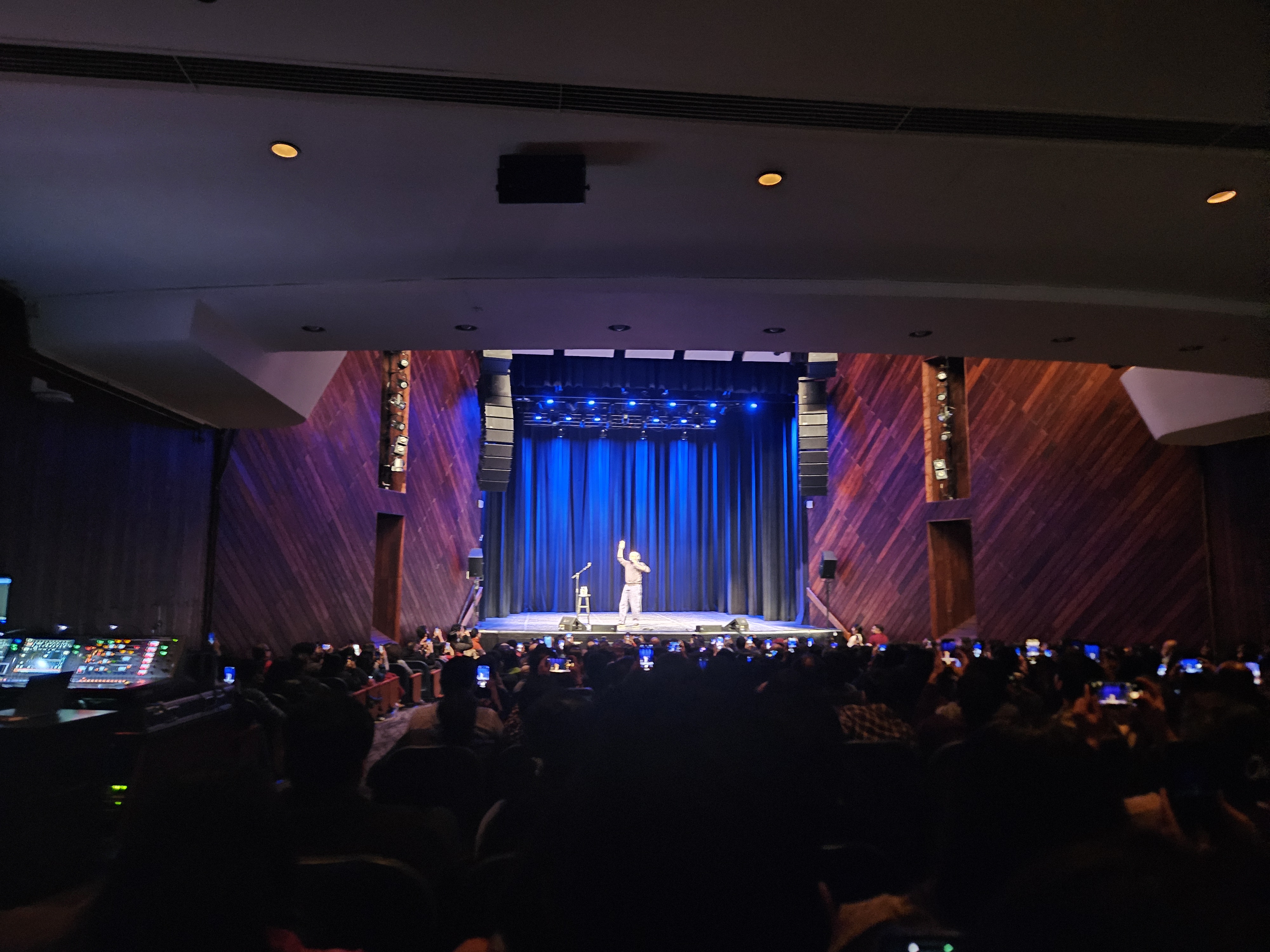
A few weeks later, one of my a cappella group mates mentioned that her parents were going to see a Hindi stand-up comedian named Biswa Kalyan Rath. It turned out that he was also coming to Boston a couple weeks later, so we started putting together a group. This show was actually in Boston at the Berklee Performing Center, so just a straight shot down Mass Ave on the 1 Bus instead of complicated rental car shenanigans.
The group this time was the same Marathi friend as before (who was similarly proficient in Marathi but actually fluent in Hindi) as well as two more (Tamil) friends. Both of the Tamil friends' parents had grown up in Hindi-speaking areas and so spoke Tamil with their kids at home and then used Hindi as a "secret" parents-only language at home, so my friends had picked up enough conversational Hindi over the years for it to be worth their while.
Assessments of my Marathi abilities vary, but the statement "I speak Marathi" is relatively uncontroversial. However, I do not speak any Hindi, and I would never claim to speak Hindi. I had only watched one or two Bollywood movies before grad school, so there was no large body of memorized lines or songs upon which I could rely, either. Nevertheless, despite already having only understood half of the prior stand-up show in the language I do speak, I decided I'd attend this Hindi stand-up show as well, just for fun and to see how much I could figure out.
The hall was packed and the crowd erupted in laughter after every joke, which implied that the show was very funny. Among my party, the Marathi speaker understood all of it and the Tamil speakers understood pretty much all of it, and they all concurred that it was a very funny show. I also thought it was funny, but in contrast I only comprehended around 10% of the Hindi words, due to the fact that I don't speak Hindi.
Luckily, modern Hindi is peppered with a lot of English, so where applicable I was able to use the surrounding context clues to extrapolate and figure things out at a much higher clip than at the Marathi show. (Also the comedian is an IIT grad, so many of the jokes were related to technology and were mostly in Hinglish). Sometimes I could also dig deep and think hard and sort of figure out the meaning of Hindi words or phrases based on similar Marathi words I knew. Over the few months before the show I had also incidentally learned a handful of common Hindi words (mostly through repeatedly Google translating popular movie titles and whatever other auxiliary words frequently appeared in subtitles of whatever Hindi YouTube content I ingested) such as matlab (funny to read in subtitles), dil, zindagi, etc.
I know a few people who learned Hindi by watching Bollywood movies, and after watching these two stand-up shows and basically learning a bit of Hindi through the second show, I can definitely see the appeal of learning languages this way. Despite my general lack of comprehension during the show, I declared immediately after that I'd be down to watch another Hindi stand-up comedy show in the near future. In general, I'd love to strengthen up my Hindi skills through continued exposure to Hindi entertainment content. I think the visual, immersive format (common to both a live performance and a movie) makes it easier and more enjoyable to learn, even if one doesn't understand all that much.
As one final point about the stand-up show itself, there was one extended bit in (pseudo-)Sanskrit that I was able to follow quite well, thanks to whatever grammar and vocabulary I've picked up over the years.
On speaking heritage languages as a third-generation immigrant
Conversation proficiency and literacy
For a while, I've been saying that I'm conversationally proficient but in some sense illiterate in Marathi. I can converse and mostly hold my own with native Marathi speakers, and all things considered (given my background) I have a reasonably diverse vocabulary (according to my extended family).
Mechanically, I am literate, so claiming that I'm illiterate is sort of for shock value. I can read and write Marathi in the Devanagari script (technically Balbodh?), and the speed at which I can do so ebbs and flows based on how much practice I get. In recent months, I've been taking Hindustani classical vocal lessons, so I've been reading and writing a lot more Devanagari (my deliberate choice over romanized transliterations), and I can notice a speedup in my reading and writing that mirrors past stretches where I've done a lot of Sanskrit learning with my grandfather. (My handwriting also looks nicer and less childlike after the past ten months.)
But I think there is more depth to literacy than just whether I can read and write. What I can read and write is also of some importance. I lack the ability to read a Marathi literary passage and understand its nuances. Many people talk about Marathi poetry (or poetry in general) as being culturally relevant and interesting, but I wouldn't be able to make heads or tails of it, let alone write something interesting myself. I also wouldn't be able to follow a play, which sort of falls under "listening" and not reading/writing, but I think it's fair to include it under literacy and not conversational proficiency. So there's a considerable gulf between my relationship with Marathi and the relationship of someone who's truly fluent.
My past and my future
As I mentioned above, Marathi is formally my first language. I'm a third-generation Marathi-American--my mom was born and raised in the US, and my dad was born in Europe and moved to the US at 3--and my parents managed to privilege Marathi in our household for as long as they could, before the outside world of school and extracurricular activities promoted English to the top. Whenever I look back and think about how they pulled this off, without the infrastructure of a local Marathi language school or other fellow second-generation Marathi families with fellow Marathi-speaking third-generation kids in our community, I'm quite impressed.
My parents themselves are competent Marathi speakers (although they can't really follow along with the literary stuff either), mostly because they grew up spending their summers in India with their grandparents and aunts and uncles and cousins, all of whom spoke Marathi and many of whom spoke English sparingly. (One caveat is that my parents understand the grammatical gender system and how it affects conjugations and whatnot, but they're quite inaccurate at determining which nouns actually belong to which gender. Usually, I think this sort of error would be corrected by parents or extended family. At some point last year, I asked one of my extended family members why she or the family never bothered to correct my mom on noun genders, and she replied that they all found it cute that my mom, who had come all the way from far away America, was speaking Marathi, and so they didn't feel like correcting her grammatical mistakes. I would guess the same was true for my dad.)
In contrast, when I'm with my grandparents (who have been in the US since the 1960s and 1970s and have been in driving distance in Texas for basically all of my life), most conversations start in Marathi (my choice) but quickly derail into English (their habit after sixty years here) despite my repeated requests of "Marathi bol!" And my India trips were to an increasingly Anglicized place where this same extended family--my parents' aunts and uncles and the subset of their cousins who didn't emigrate--now default to English when talking with us, out of their own convenience.
In recent years, I've sought to shore up my Marathi skills. I think this results from an underlying desire to feel more connected to my heritage and culture. In particular, I love stories, especially the ones that my grandparents tell, and so I imagine some element of my interest in Marathi is to better understand the context that my grandparents grew up in and the piece of it that my parents (and I) were raised in. So I was quite proud of the fact that I was able to attend a Marathi stand-up comedy show and understand as much of it as I did.
In the summer before grad school, I bought a (paperback) Marathi grammar book (originally published in 1880 and written in English, so likely for outsiders), and I made my way through the first fifty pages with the (ongoing) goal of sitting down at some point and systematically studying the whole thing. That summer, I also found a few recently-written Marathi textbook PDFs. But it's hard to learn through just books, and the best mechanism for maintaining my speaking skills is of course to speak more.
I try my best to speak in Marathi as much as possible, but this is often a losing battle, for logistical and personal and emotional reasons. Every Marathi speaker I know (family, friends, singing teacher, etc) speaks English much better than I speak Marathi. So I end up spending extra time trying to construct Marathi sentences to express complex thoughts that I could easily express in English, and this often feels incredibly disabling, especially since the safety valve of switching to English is right there. I wonder how common the experience is of feeling like one is unable to communicate in one's native language.
These experiences often have me wondering what role language serves in our increasingly globalized and Anglicized world, and I'm specifically prompted to think about my past and future relationship with Marathi. There are clearly those words and concepts that are unique to Marathi (and culturally similar languages), and having access to that additional Marathi vocabulary does certainly give me a shorthand that can't be replaced. But I don't think I'd be content if the extent of my Marathi was speaking English peppered with Marathi words. So at least based on what I've written up to this point, it seems imperative that I speak Marathi well!
I'm still reflecting and I don't have any final answers. For now, the best I can do is speak as much Marathi as possible and ingest as much Marathi content as possible and hope that I can develop and improve my speaking and comprehension skills in the process.
Main still Hindi boltaa nahin
As for Hindi, I have much less of a personal relationship with it since it's "that language in the Bollywood movies" rather than "my native language."
But perhaps one thing I learned from my Hindi stand-up experience is how adaptable we are. I was a bit impressed that I was able to figure out a few words of Hindi over the course of the show, and I was proud that I was relatively zoned-in despite being somewhat lost some of the time. It was a fun adventure for sure, mostly type 1 fun but a little bit type 2, to be honest, since it was a bit daunting to think about how I was definitely the only person in the entire venue who didn't speak the language of the show. (Unlike the Marathi show, I would have been completely lost here if I was the subject of Hindi crowdwork!)
In retrospect I don't think picking up a few scraps of Hindi is that impressive of an accomplishment, all things considered. Learning languages is often treated with special status in the US school system, but it seems like much more of a mundane process in other corners of the world. I've observed, while in Central Europe and India (and I'm sure this is true across the rest of the world), that it's common for people to be fluent or at least proficient in several languages, especially in places where different linguistic groups live in close proximity. Someone might speak their mother tongue, the official regional language, the official national language, and English. You don't make a big deal about it, you just figure out what languages you need to know to interact with fellow members of your society and you just make it happen.
I guess we do practice this sort of unstructured multilingualism in our society, and I do have a few personal examples. My Indian-American friends in the Ohms and beyond often pick up random vocabulary words in other South Asian languages and repeat them over and over and over and over again. Every so often I'll use Google translate to learn a new random Tamil or Hindi word, often one that's a recurring lyric or song title in the Ohms repertoire. And on a larger and more meaningful scale, my dad has figured out enough Spanish over the years to be very capable at communicating with patients of his (or more often, their family members) who may not speak English. So it seems in practice we also just adapt and figure out the best ways of communicating with others around us, in whatever language that might be.
I don't know if this resolves my questions about Marathi, but it at least gives me some directions to think about language as a means of identity, culture, community, and connection.